


Why Villas? — Dubai
Why Choose a Villa in Dubai?
A villa can combine qualities that few property types bring together within one asset:
- a private home
- greater space and privacy
- a relationship with private land
- outdoor living
- family flexibility
- greater control over the physical property
- rental and resale optionality
- long-term ownership value
For some buyers, the decision is primarily about the way they want to live. For others, it is about protecting capital, creating rental income, holding a scarce physical asset or building long-term family wealth. For many, it is both. The right villa decision begins by aligning the lifestyle, capital, community, property and time horizon.
More than a home. More control over how you live, own and create value.
Five Forms of Value
One Property Can Serve More Than One Purpose
A villa should not be evaluated only by its bedroom count, purchase price or expected rent. Its complete value may come from five different sources.
Living Value
The daily benefit of privacy, family space, outdoor living, independence and a home designed around the household.
Land Value
The relationship between the villa and its private plot, including size, position, orientation, privacy and outdoor potential.
Control Value
The owner may have greater ability to maintain, personalise, improve or reposition the property, subject to technical feasibility, approvals and community rules.
Financial Optionality
A suitable villa may provide rental income, future resale potential, long-term capital appreciation or value creation through disciplined improvement.
Legacy Value
The villa may continue as a family home, future rental property, saleable asset or long-term family holding.
Owner-occupier perspective
Living in the villa does not mean the capital has disappeared. The household receives the use of the property while ownership remains represented by a physical asset that may later be retained, leased, improved or sold.
Investor perspective
The property may provide income or long-term capital potential, but performance depends on the acquisition price, community, property, costs, holding period and exit strategy.
A villa can produce lifestyle value while the capital remains invested in a physical asset.
A Diverse Villa Market
Dubai Offers More Than One Way to Own a Villa
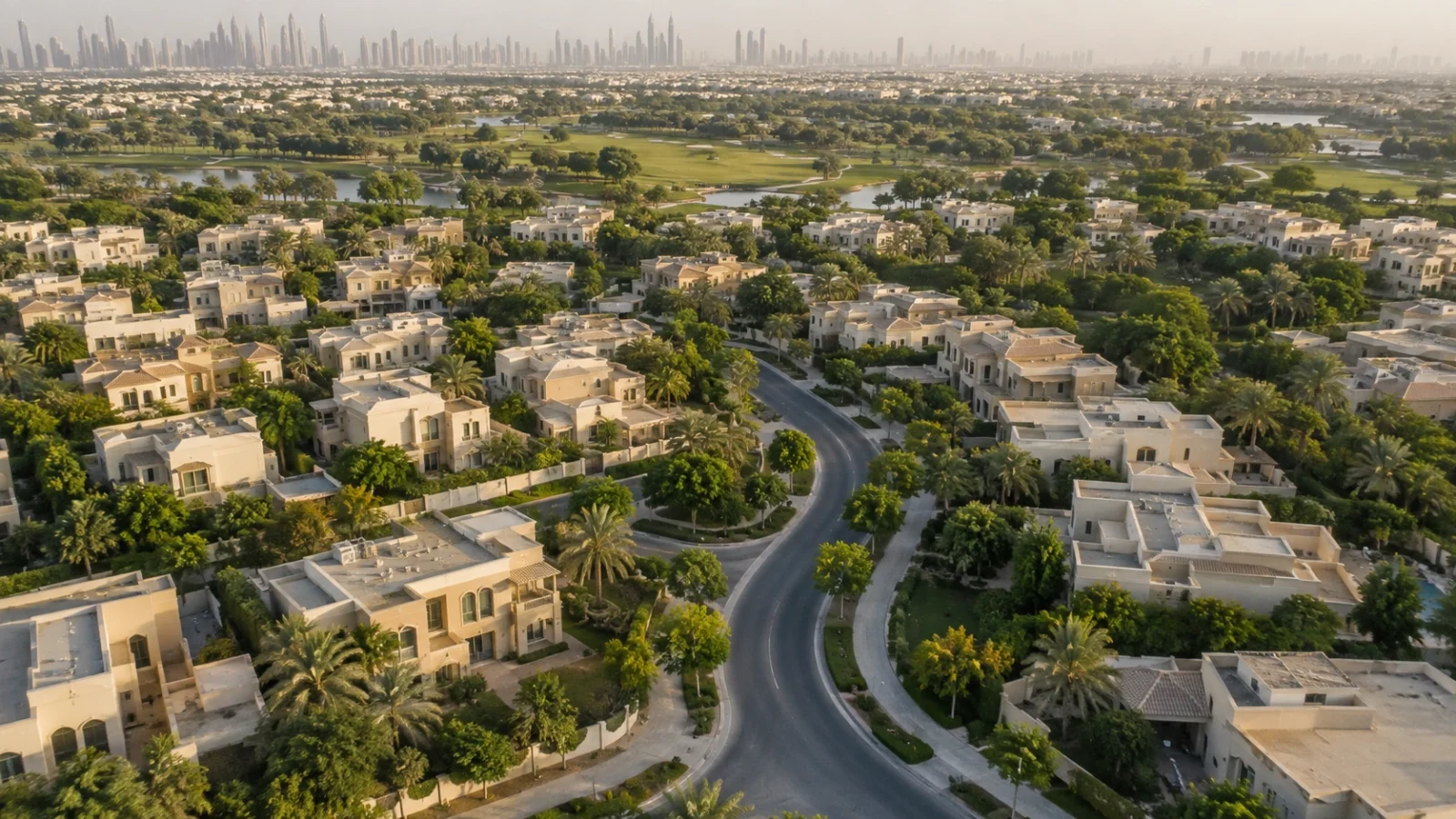
Dubai’s villa category includes different communities, property formats, delivery stages and ownership strategies. The buyer is not limited to one standard villa model.
Established Community Living
Mature neighbourhoods may provide observable daily life, established landscaping, facilities, resale activity and a range of original, renovated and rebuilt homes.
New and Emerging Communities
Newer destinations may provide contemporary villa formats, planned lifestyle environments and the opportunity to enter before the wider community is fully mature.
Lifestyle-Led Environments
Villa communities may be shaped around:
- family living
- golf
- waterfront
- greenery
- wellness
- equestrian living
- urban luxury
- integrated city-scale facilities
Different Property Pathways
A buyer may choose among:
- Ready Villas
- Off-Plan Villas
- Custom Build
- Upgrade and Repositioning
- Townhouse alternatives
Different Ownership Objectives
The same villa category can support:
- family occupation
- future relocation
- rental income
- long-term holding
- upgrading
- future resale
- legacy ownership
Important distinction. The existence of many pathways does not make every villa suitable. The objective should determine the community, property format and ownership route.
The Human Value
A Villa Should Improve the Way the Household Lives
The lifestyle advantage is not simply a larger floor area. It is the ability to organise the home around the household’s real needs.

Space With Purpose
A suitable villa may create clearer separation between:
- family living
- formal entertaining
- bedrooms
- work
- staff and service areas
- guests
- storage
- private and shared zones
Greater Privacy
A villa may provide more independence from shared corridors, lifts and directly adjoining units. Actual privacy still depends on:
- plot position
- neighbouring villas
- orientation
- window placement
- landscaping
- internal layout
Outdoor Living
Gardens, terraces, pools, courtyards and shaded spaces can extend daily life beyond the internal building. Outdoor areas may support:
- children
- pets
- exercise
- family gatherings
- entertaining
- relaxation
- gardening
- private recreation
Multigenerational Flexibility
A suitable villa may accommodate:
- growing children
- older parents
- adult family members
- guests
- staff
- ground-floor living
- home offices
- future household changes
Personal Identity
The property can reflect the family’s way of living more directly than a standardised unit.
A villa is not valuable only because it is larger. Its value comes from how well it supports the people living in it.
More Than an Interior Unit
A Villa Combines the Building With the Plot Around It
An apartment owner primarily controls the internal unit. A villa owner may control several connected parts of the asset.

The Building
The private structure, internal layout, systems, façade and condition.
The Plot
The land relationship, including:
- frontage
- depth
- orientation
- privacy
- road position
- side spacing
- garden potential
- parking
- views or outlook
The Outdoor Environment
Landscape, pool, terraces, gates, driveway, lighting and privacy treatments form part of the complete property.
Adaptability
A suitable villa may be reconfigured or improved as the family’s needs change.
Individual Repositioning
Subject to feasibility and approvals, a villa may allow:
- internal reconfiguration
- technical-system replacement
- landscape redesign
- façade improvement
- pool work
- extensions
- substantial renovation
- rebuilding in appropriate cases
Important clarification. Apartments can be renovated internally, and townhouses may also be improved. However, these formats normally provide less individual control over the external structure, plot relationship and complete identity of the asset.
Greater control creates greater opportunity — but it also creates greater responsibility.
Why Some Villas Perform Differently
The Word “Villa” Does Not Create the Value
Two villas in the same city — and even within the same community — can produce very different lifestyle and financial outcomes. The result is shaped by the combination of several factors.
Objective
The villa should be selected according to what it must achieve: family use, rental income, long-term holding, upgrading, resale or legacy ownership.
Community
Lifestyle, maturity, infrastructure, schools, access, demand, management and future supply affect the property’s wider position.
Developer and Community Stewardship
The original planning, delivery and continuing community environment can influence long-term confidence and liveability.
Plot and Position
Corner, park, golf, waterfront, internal-road, main-road and private positions may attract different audiences and values.
Property
Layout, condition, architecture, size, systems, privacy and improvement potential affect the individual asset.
Entry Price
A strong property can still become a weak investment if the buyer pays an excessive price.
Holding and Execution
Maintenance, tenancy, improvement, financing, timing and the eventual exit decision shape the ownership outcome.
No individual factor guarantees appreciation or rental performance. A recognised developer, premium community or large plot cannot replace disciplined acquisition and property-specific review.
Choose the Right Property Format
Different Property Types Solve Different Problems
A villa is not automatically better than an apartment or townhouse. Each property format offers a different balance of capital, privacy, maintenance, control, liquidity and lifestyle.
| Decision factor | Apartment | Townhouse | Villa |
|---|---|---|---|
| Entry capital | Commonly lower | Usually mid-range | Commonly higher |
| Private land | Usually none | Smaller private area | Greater plot exposure |
| Privacy | Shared-building setting | Moderate | Potentially greater |
| Outdoor space | Balcony or shared amenities | Compact private space | Potential for larger private garden, terrace or pool |
| Structural control | Limited | Moderate and regulated | Potentially greater, subject to approvals |
| Upgrade scope | Mainly interior | Interior and limited exterior | Interior, exterior, landscape and possible expansion |
| Individual differentiation | Unit, floor, view and condition | Community, position and condition | Plot, position, architecture, condition and improvement |
| Maintenance | More building-managed | Shared and private | Greater owner responsibility |
| Diversification | Easier across several units | Moderate | More concentrated |
| Rental management | Often simpler | Community-dependent | More property-specific |
| Liquidity | Often broader buyer pool | Community-dependent | More price- and property-specific |
| Lifestyle fit | Convenience and facilities | Family-community balance | Privacy, space and control |
| Long-term value potential | Strong in suitable buildings and locations | Dependent on community and product | Strongly affected by land, scarcity, condition and execution |
Apartment
- Entry capital
- Commonly lower
- Private land
- Usually none
- Privacy
- Shared-building setting
- Outdoor space
- Balcony or shared amenities
- Structural control
- Limited
- Upgrade scope
- Mainly interior
- Individual differentiation
- Unit, floor, view and condition
- Maintenance
- More building-managed
- Diversification
- Easier across several units
- Rental management
- Often simpler
- Liquidity
- Often broader buyer pool
- Lifestyle fit
- Convenience and facilities
- Long-term value potential
- Strong in suitable buildings and locations
Townhouse
- Entry capital
- Usually mid-range
- Private land
- Smaller private area
- Privacy
- Moderate
- Outdoor space
- Compact private space
- Structural control
- Moderate and regulated
- Upgrade scope
- Interior and limited exterior
- Individual differentiation
- Community, position and condition
- Maintenance
- Shared and private
- Diversification
- Moderate
- Rental management
- Community-dependent
- Liquidity
- Community-dependent
- Lifestyle fit
- Family-community balance
- Long-term value potential
- Dependent on community and product
Villa
- Entry capital
- Commonly higher
- Private land
- Greater plot exposure
- Privacy
- Potentially greater
- Outdoor space
- Potential for larger private garden, terrace or pool
- Structural control
- Potentially greater, subject to approvals
- Upgrade scope
- Interior, exterior, landscape and possible expansion
- Individual differentiation
- Plot, position, architecture, condition and improvement
- Maintenance
- Greater owner responsibility
- Diversification
- More concentrated
- Rental management
- More property-specific
- Liquidity
- More price- and property-specific
- Lifestyle fit
- Privacy, space and control
- Long-term value potential
- Strongly affected by land, scarcity, condition and execution
Apartment
May suit buyers prioritising
- lower entry capital
- diversified ownership
- passive building management
- multiple rental units
- easier partial disposal
Townhouse
May suit buyers prioritising
- family-community living
- practical space
- moderate outdoor areas
- a middle position between apartment and standalone-villa ownership
Villa
May suit buyers prioritising
- private land
- space and privacy
- long-term family ownership
- greater physical control
- improvement potential
- a differentiated asset
The correct property type is the one that best supports the buyer’s objective — not the one with the highest status or purchase price.
Concentration or Diversification
What Should the Property Capital Achieve?
A buyer with AED 10 million may consider one villa, several apartments, a townhouse and additional investments, or a mixed property portfolio. There is no universal answer.
Several Apartments May Provide
- diversification across properties
- multiple tenants
- several rental-income streams
- lower dependence on one property
- easier partial disposal
- potentially broader liquidity
- more building-managed maintenance
- flexibility to sell one unit without exiting the complete portfolio
Strategy strength. Diversification, multiple income sources and potential liquidity.
Main limitation. Less individual control, less private-land exposure and more standardisation.
One Villa May Provide
- personal occupation
- private-land exposure
- a differentiated physical asset
- greater individual control
- family or premium-tenant appeal
- broader upgrade potential
- scarcity based on plot and position
- a potentially higher long-term value ceiling
- emotional and legacy value that a portfolio may not provide
Strategy strength. Lifestyle, physical control, land, adaptability and long-term positioning.
Main limitation. Greater capital concentration, maintenance responsibility and dependence on one property.
Mixed Strategy
A buyer does not always need to choose only one category. A mixed strategy may combine:
- a family villa
- income-producing apartments
- another liquid or diversified investment
- reserve capital for ownership and maintenance
Several apartments may suit a diversified income strategy. A villa may suit a concentrated lifestyle, private-land and long-term capital strategy. The objective decides.
Two Ownership Objectives
Personal Use and Financial Value Can Exist Together
A villa can serve an owner-occupier and an investor in different ways.

Owner-Occupier and Family Home
Main objective
- daily quality of life
- privacy
- family stability
- school and commute alignment
- long-term residence
- outdoor living
- multigenerational use
- future adaptation
Financial relevance
The family is using the property, but the villa may remain:
- a long-term owned asset
- a future rental property
- a future resale property
- an upgradeable asset
- a family or legacy holding
An owner-occupied villa should not be judged only by annual rental yield.
Investor and Wealth-Building Asset
Main objective
- rental income
- long-term holding
- capital appreciation
- strategic resale
- value creation through improvement
- future home buyer demand
Investment relevance
The investor should review:
- acquisition price
- tenant audience
- achievable rent
- ownership costs
- community maturity
- future supply
- plot and property quality
- holding capacity
- exit audience
Investment performance begins with the acquisition decision — not with the word “villa.”
Not every attractive family home is a strong investment asset. Not every investment-led villa is the right long-term home for a particular family.
Ownership Outcomes
Value May Come From More Than One Route
The same villa may support several ownership outcomes over time.
Rental Income
A completed villa may generate recurring income where the acquisition price is disciplined, the tenant audience is clear, layout and condition are suitable, rent supports ownership costs, and vacancy and maintenance are controlled.
Gross rent should not be confused with net investment return.
Community Maturity
A property acquired in a developing community may be held while occupation increases, landscaping matures, facilities open, roads improve, the community develops a clearer identity and the resale market deepens.
Maturity may support the wider position, but it does not guarantee appreciation.
Improvement and Repositioning
A well-selected villa may be improved through maintenance, technical upgrades, layout refinement, landscape, interiors, façade improvement and larger repositioning where feasible.
Improvement should be based on the asset and intended audience — not renovation for its own sake.
Long-Term Resale and Legacy
The owner may eventually resell, lease, refinance, retain the property, pass it to the family or use it for a different household purpose.
Selected historical case studies are selected outcomes — not normal or guaranteed community results.
Evidence bridge. Selected historical case studies may demonstrate how certain villas produced rental income or capital appreciation. They should be presented as selected outcomes — not as normal or guaranteed community results.
The Other Side of Ownership
The Advantages of a Villa Come With Greater Responsibility
A villa may provide more control than a standardised property, but the owner must also carry more responsibility.
Advantages and Control
A villa may provide more control than a standardised property — over the building, the plot, the outdoor environment and long-term repositioning. Holding power gives the community and ownership strategy time to develop.
Holding power gives the community and ownership strategy time to develop. It does not guarantee that the strategy will succeed.
Responsibilities and Risks
- Capital Concentration. A larger amount of capital may be concentrated in one property.
- Maintenance. Building systems, roof and waterproofing, cooling, plumbing, electrical systems, pool, landscape, façade and general repairs.
- Operating Costs. Community or service charges, insurance, utilities, landscape and pool maintenance, management, vacancy and finance costs.
- Holding Capacity. Villa ownership may be unsuitable when the buyer could be forced to sell because of short-term cash-flow pressure.
- Liquidity. A specialised or high-value villa may take longer to sell than a more standardised and lower-priced property.
- Property-Specific Risk. Condition, plot, road position, privacy, modifications and maintenance can materially influence demand.
- Management. Rental villas may require more active property management than standard apartments.
When a villa may not be the right choice. A villa may be less suitable when the buyer prioritises:
- low entry capital
- maximum diversification
- minimal maintenance
- immediate liquidity
- easy partial disposal
- fully passive ownership
- very short holding periods
- low operational complexity
The purpose is not to recommend a villa to everyone. It is to identify when a villa is the right asset for the objective.
One Category. Different Strategies.
How Do You Want to Own the Villa?
Once the villa category is suitable, the next decision is the ownership pathway.
Ready Villa
For buyers who prioritise
- physical inspection
- observable community life
- immediate or near-term possession
- clearer property-condition review
- direct price negotiation
Off-Plan Villa
For buyers who prioritise
- future ownership
- staged payments
- modern property formats
- upcoming communities
- longer planning horizons
Custom Build
For buyers who prioritise
- private land
- greater design control
- family-specific planning
- individual architecture
- long-term adaptability
Upgrade Villa
For owners or investors who want to
- retain or buy into a strong location
- improve an under-positioned property
- adapt an existing villa
- reposition it for living, rental or resale
Townhouse Alternative
For buyers who want
- low-rise family living
- private outdoor space
- community facilities
- a more moderate capital and maintenance position
Choosing a villa is only the first decision. The ownership pathway determines the timing, control, capital and execution requirements.
Buy With Purpose
Do Not Begin With the Villa You Like
Begin with what the property and invested capital must achieve.

- Define the Objective
- Understand the Capital
- Select the Community Direction
- Select the Property and Plot
- Define the Ownership Route
- Verify Before Commitment
Define the Objective
Clarify whether the villa is intended for family use, relocation, rental income, long-term holding, upgrading, future resale or legacy ownership.
Understand the Capital
Review acquisition budget, finance, transaction costs, maintenance, furnishing or upgrade needs, contingency and holding ability.
Select the Community Direction
Align lifestyle, schools, commute, maturity, developer, tenant or buyer audience and future supply.
Select the Property and Plot
Review property format, layout, condition, plot, privacy, orientation, position and adaptability.
Define the Ownership Route
Decide whether the likely strategy is to occupy, rent, hold, improve, refinance, resell or retain for the family.
Verify Before Commitment
Use relevant market evidence, property inspection, legal and transaction review, finance review, technical advice and licensed professional support.
The objective determines the strategy. The strategy determines the community. The community determines the property shortlist.
The Villas Dubai Advisory
Decide Whether a Villa Is the Right Asset Before Choosing Which Villa
Clarify the Objective
Understand the family, lifestyle, financial and ownership purpose.
Compare Property Types
Compare villa, townhouse, apartment or a mixed-property strategy.
Select the Villa Pathway
Choose between Ready, Off-Plan, Custom Build or Upgrade.
Compare Communities
Review location, maturity, lifestyle, developer, property formats and market context.
Review the Asset
Assess the villa, plot, condition, market position, ownership cost and future flexibility.
Define the Long-Term Route
Clarify whether the strategy is to live, rent, hold, improve, refinance, resell or retain for the family.
What we do not do
- We do not begin with a mass list of properties and ask the buyer to choose.
- We do not claim that every villa is a better investment than an apartment.
- We do not guarantee rental income, appreciation or resale timing.
We begin by asking what the asset should achieve.
Common Questions
Why Villas? FAQs
Are villas always better investments than apartments?
Why buy one villa instead of several apartments?
Can an owner-occupied villa still build wealth?
Do villas always appreciate more than townhouses or apartments?
Can villas generate rental income?
Why does private land matter?
Do villas offer more upgrade potential?
Can every villa be extended or rebuilt?
How long should a villa be held?
What are the main responsibilities of villa ownership?
Is a townhouse a practical alternative?
Should I choose Ready, Off-Plan, Custom Build or Upgrade?
How do I decide whether a villa is right for me?

Make the Asset Decision First
Choose the Property Type for the Life and Value You Want to Create
A villa may provide family space, privacy, private land, outdoor living, rental potential, improvement options and long-term ownership value. It is not automatically the right property for every buyer. The right outcome begins with the objective, capital, community, property and ownership strategy.
Choose for how you want to live, what you want to own and what the capital should achieve.